
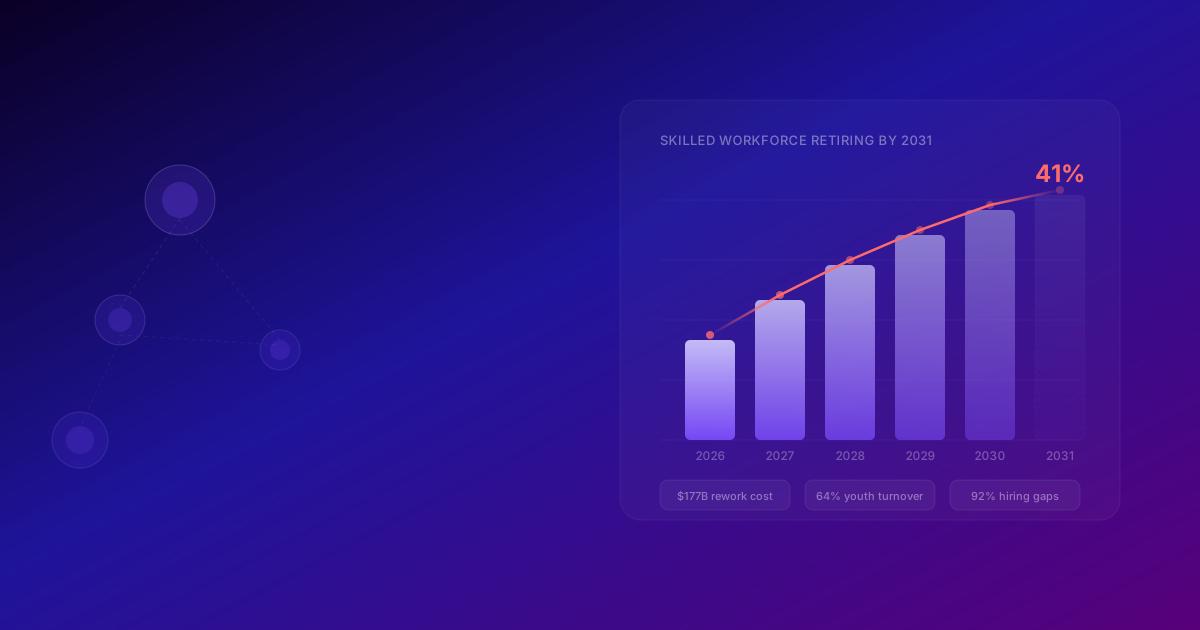
According to the National Center for Construction Education and Research, 41% of construction's current skilled workforce is expected to retire by 2031. That is not a distant projection. It is eight years away, and the preparation across most organisations is nowhere near proportionate to the scale of what is being lost.
This is not primarily a recruitment problem. It is a knowledge problem. And the two require very different responses.
What is actually leaving when an experienced person retires
Senior engineers, procurement directors, and project leaders carry something that does not appear on any CV or system. They carry judgement. The kind that tells you a price is too low before the numbers confirm it. The kind that knows which contractor will underperform under pressure, or where a programme is likely to break before anyone has raised a flag.
This knowledge was not built in a classroom. It was built through years of structured mentorship, deliberate exposure, and the freedom to fail in lower-stakes environments while someone more experienced was watching.
That transfer mechanism is now under significant strain.
The CIOB's ageing workforce report found that 97% of construction professionals believe mentoring is either valuable or very valuable. Yet only 63% say it regularly happens in their organisations. The gap between those two numbers is not explained by indifference. It is explained by workload. A 2025 survey by the Associated General Contractors of America found that 92% of contractors are struggling to fill open positions. The people who should be mentoring are simply too stretched to do it consistently.
The result is a generation of talented professionals being placed on complex programmes without the informal support that has always been central to how this industry passes knowledge forward.
The cost is already measurable
Poor knowledge transfer is not an abstract risk. It has a direct financial consequence.
Research from FMI and PlanGrid found that inefficiency and rework cost the US construction industry $177 billion in labour annually. 48% of that rework stems from poor communication and inaccurate information. Not from bad materials or poor design. From people not knowing what someone more experienced would have known to check.
The pattern is consistent. When knowledge does not transfer, decisions suffer. Evaluations become inconsistent. Mistakes that an experienced eye would have caught early become expensive corrections later. And the junior professionals caught in the middle, carrying responsibility without adequate support, often leave. Construction workers under 25 show a turnover rate of around 64%. Each departure resets the clock on months of accumulated project learning.
This is a decisions problem, not just a people problem
There is a tendency to frame the knowledge crisis in construction purely as a talent pipeline challenge. Recruit more. Train faster. Build better pathways into the industry.
All of that matters. But it misses something important.
The knowledge that is most at risk is not procedural knowledge. It is not the kind that can be captured in an induction programme or a training module. It is the kind that shapes how a complex decision gets made. How competing bids get evaluated. How risk gets surfaced and weighed. How a team arrives at a conclusion they can actually defend.
This is where the loss compounds most painfully. Because as the experienced people leave, the decisions that remain do not get simpler. The programmes get larger, the tenders more complex, the scrutiny more intense. Organisations are being asked to make better decisions with less institutional knowledge to draw on.
What senior leaders can do about it
The most honest thing to say is that there is no single fix. But there are meaningful starting points.
The first is recognising that mentorship is not a nice-to-have programme. It is the primary mechanism through which construction has always transferred critical knowledge, and it needs to be protected with the same seriousness as project delivery. That means creating space for it, not just endorsing it in principle.
The second is acknowledging that some of what experienced people know can be captured, structured, and made accessible in ways that reduce the dependency on any one individual. Evaluation frameworks, scoring methodologies, decision rationale, and historical bid data are all forms of institutional memory that organisations can begin to systematise.
The third is ensuring that the decisions made during pre-construction, where the stakes are highest and the judgement requirements most complex, are supported by processes that do not rely entirely on the expertise of whoever happens to be in the room.
At TruBuild, we work with organisations navigating exactly this challenge. Our platform helps procurement and evaluation teams bring structure, consistency, and auditability to the decisions that matter most, at the stage of a project where getting it right is still possible. We do not replace the judgement of experienced professionals. We help organisations ensure that judgement is captured, documented, and applied consistently, regardless of who is in the room.
The knowledge is still there, for now. The question is how much of it survives the transition.
TruBuild is a decision intelligence platform for construction procurement. It helps project owners, developers, and consultancies evaluate bids, compare vendors, and document procurement decisions with greater consistency and auditability. Learn more at trubuild.io